Your cloud, your data
Runs in your database. Your data stays safe and secure in your environment.
OpenRetailScience is open source retail analytics that runs in your database, handles billions of rows, and gives you back control of your KPIs.

What's included
From customer segmentation to revenue trees. Every module is tested, documented, and ready to use.
Runs in your database. Your data stays safe and secure in your environment.

Modules for churn, gain-loss, cross-shop, segmentation, revenue trees, and more.

Every calculation is auditable and yours to extend, with no dependency on a third party's roadmap.

Python only orchestrates. Tested with retailers on their own transaction data.
Databricks, Snowflake, BigQuery
Among ~20 supported database backends
Billions
Of rows handled. The heavy lifting happens in your database, not in Python
Days, not years
From data to business value. Pre-built modules for the analyses you keep rebuilding
Open Source
No vendor lock-in, no black boxes, no data leakage
From quick analyses to end-to-end workflows, see what you can build. Every chart here was drawn by OpenRetailScience with its default styling.
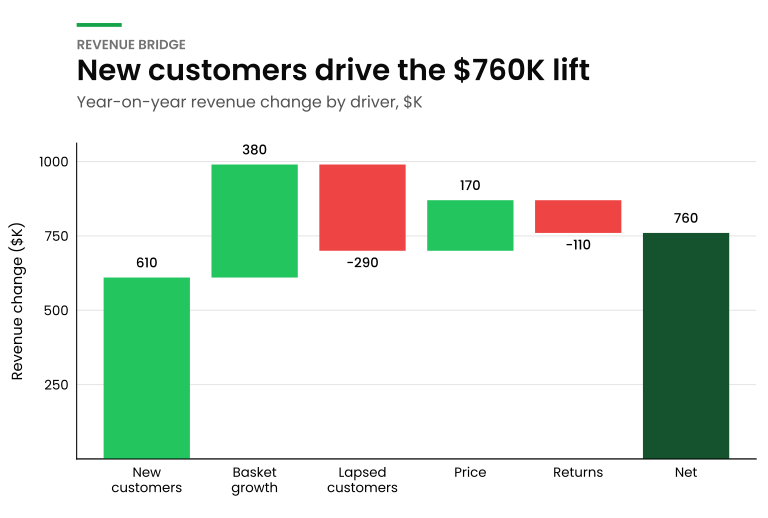
waterfall.plot() turns a list of drivers into a board-ready revenue bridge.
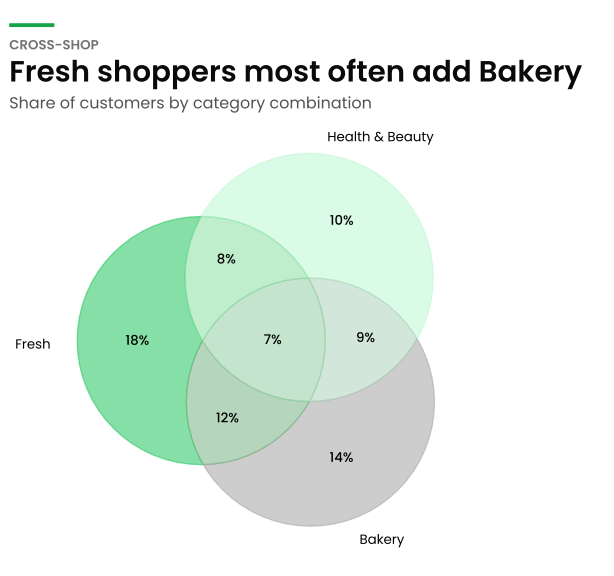
See how customers shop across categories, brands, or stores with automated Venn diagrams and overlap metrics.
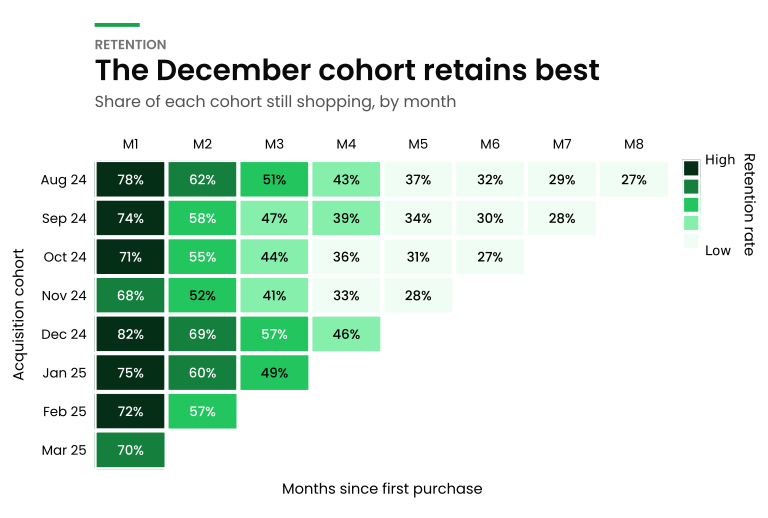
Retention, spend and churn by acquisition cohort, stepped into readable bands.
from openretailscience.segmentation.hml import HMLSegmentation
from openretailscience.segmentation.segstats import SegTransactionStats

segments = HMLSegmentation(transactions)
joined = transactions.left_join(segments.table, "customer_id")
stats = SegTransactionStats(joined, grouping_sets=[("segment_name",)])
df = stats.df.set_index("segment_name")
share = df.spend / df.spend.sum()
print(f"Your top 20% of customers drive {share['Heavy']:.0%} of spend")Chain modules together. Use the output of one analysis as input for another to build complete analytical pipelines.
Install OpenRetailScience and run your first analysis in minutes. Open source, well-tested, and ready for production.
pip install openretailscience